

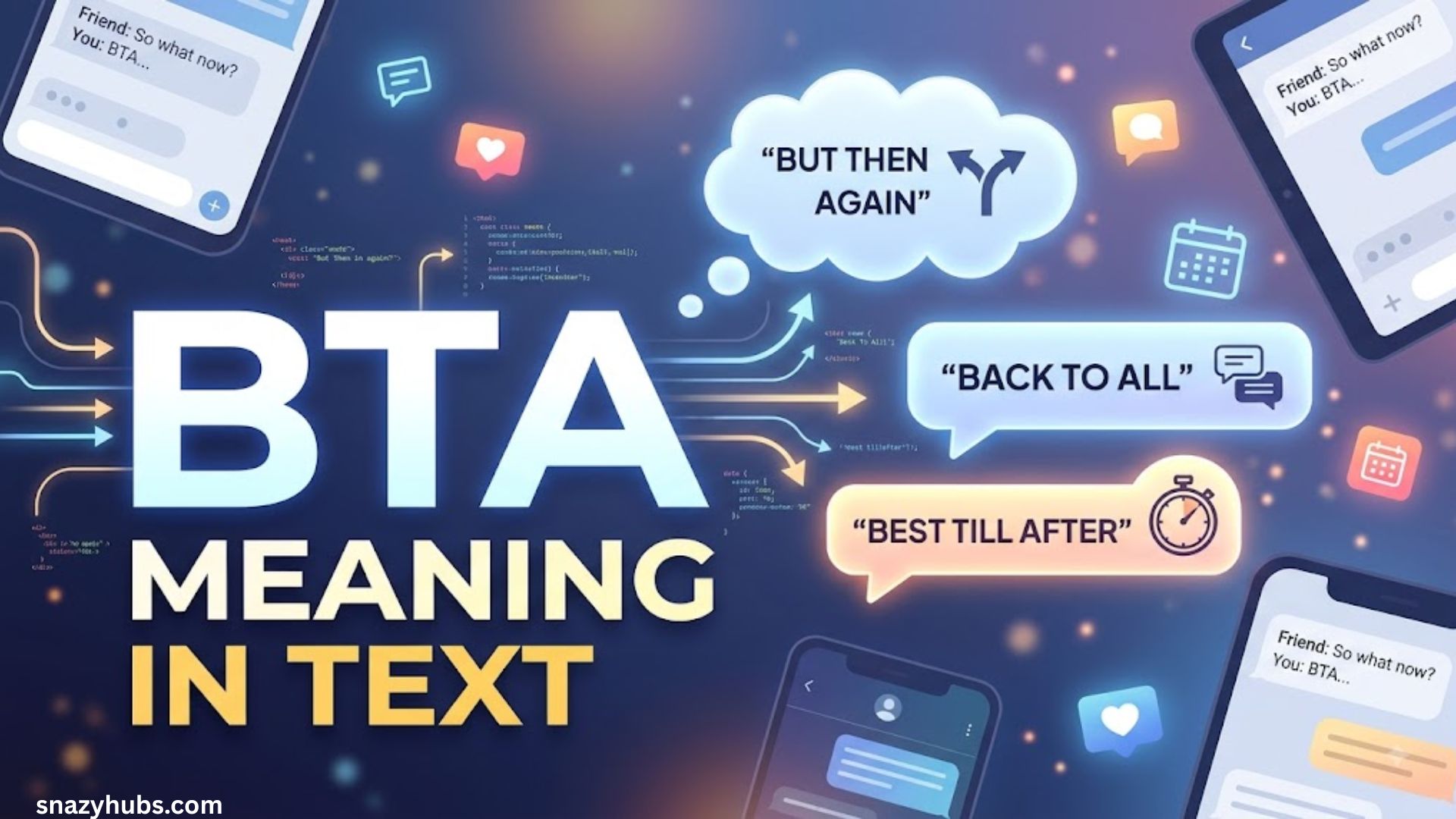
If you’ve been scrolling through TikTok comments or texting a friend and someone dropped “BTA” into the conversation, you probably paused for a second. Was that a compliment? A typo? Some new slang you missed the memo on? You’re not alone. BTA meaning in text has become one of those small abbreviations that shows up everywhere but rarely gets explained clearly.
This guide breaks down what does BTA mean in text messages, why the answer actually depends on who’s texting you, and how to read it correctly no matter where you see it. By the end, you’ll understand every major BTA texting abbreviation use, from casual American slang to South Asian chat culture, so you never have to guess again.
Quick Answer
In most American texting and social media use, BTA stands for “Better Than Average.” It’s a quick, positive way to rate something without going overboard with praise. But that’s not the only BTA abbreviation meaning out there. Depending on the group chat, the platform, or the language mix, BTA can also mean “Bout That Action” (readiness to do something, often risky) or “Bata” / “Batao” (Urdu and Hindi for “tell me”). Context decides which one applies.
TL;DR
- BTA meaning in texting most commonly translates to “Better Than Average.”
- A second, older meaning is “Bout That Action,” used to describe someone ready to do something bold.
- In Pakistan, India, and other South Asian texting communities, BTA is shorthand for “Bata” or “Batao,” meaning “tell me.”
- A less common variant, “Been There Already,” pops up occasionally in casual chats.
- The right interpretation depends almost entirely on who sent it and what platform you’re on.
Overview of BTA Meaning in Text
What the Term Represents
At its core, BTA is a compression trick. Texting culture has always rewarded speed over spelling things out, and BTA fits that pattern perfectly. Three letters can replace an entire phrase, whether that phrase is a compliment, an invitation, or a request for information. That flexibility is exactly why the BTA slang meaning isn’t fixed. It flexes to whatever the sender needs it to say in the moment.
Why People Use It
Why do people use BTA instead of just typing the full phrase? A few real reasons show up again and again:
- Speed. Typing three letters is faster than typing “better than average” or “bata.”
- Casual tone. Abbreviations signal that a conversation is relaxed, not formal.
- In-group signaling. Using slang like BTA can show you’re plugged into a particular texting culture, whether that’s Gen Z TikTok slang or Roman Urdu chat style.
- Emotional shorthand. A short reaction like “BTA” can carry more feeling than a full sentence would, because it reads as instinctive rather than composed.
What Does BTA Mean in Texting
Primary Interpretation in Messages
The most common answer to what does BTA mean in text messages, at least in American English texting and social apps, is “Better Than Average.” It’s used to rate something as solid without claiming it’s perfect. Think of it as a more casual cousin of “pretty good” or “not bad at all.”
A typical exchange looks like this:
Person A: How was the new burger place? Person B: Honestly? BTA. Would go back.
Here, BTA meaning in messages works as a light compliment. It tells the other person the experience was good, not that it changed anyone’s life.
Common Interpretations
Common interpretations of BTA split into a few clear buckets. Here’s a table that breaks them down:
| Meaning | Full Phrase | Typical Tone | Where You’ll See It |
|---|---|---|---|
| Better Than Average | Better Than Average | Positive, casual | US texting, TikTok, Instagram |
| Bout That Action | (I’m) Bout That Action | Bold, confident | Group chats, gaming, street slang |
| Bata / Batao | Bata / Batao (Urdu-Hindi for “tell”) | Curious, direct | South Asian texting, Roman Urdu chats |
| Been There Already | Been There Already | Neutral, matter-of-fact | Casual conversations about experiences |
Knowing these different meanings of BTA up front makes the rest of this guide much easier to apply in real conversations.
Common Contexts Where BTA Is Used
Everyday Text Conversations
In everyday texting, BTA in casual texting almost always leans toward the “Better Than Average” meaning when it’s used by American English speakers. People drop it into reviews of food, movies, outfits, dates, or general experiences. It works as a quick verdict.
Examples of BTA in casual conversations:
- “That show was BTA, not amazing but worth watching.”
- “New haircut is BTA fr.”
- “The exam was BTA, could’ve been worse.”
Situational Meaning Changes
Here’s where things get interesting. The exact same three letters shift meaning depending on the situation:
- In a gaming chat, “I’m BTA” often leans toward “bout that action,” meaning someone is ready to jump into a match or take a risk.
- In a South Asian family group chat, “bta” is frequently a shortened request, as in “bta kahan ho” (“tell me where you are”).
- In a product review comment, BTA almost always means “better than average.”
This is the single biggest thing to understand about BTA meaning in text: it’s not one fixed definition. It’s a flexible shorthand that depends heavily on audience and setting.
Alternative Meanings of BTA
Different Interpretations
Beyond the two dominant meanings, a few alternative meanings of BTA show up less frequently but are still worth knowing:
- Been There Already – used when someone wants to say they’ve already experienced something being discussed.
- By The Authority – a rare, more formal use that occasionally shows up in specific niche or bureaucratic contexts, though it’s uncommon in day-to-day texting.
- Regional or friend-group specific meanings – some friend groups develop their own inside-joke definition for BTA that won’t match any dictionary entry.
Why Meanings Vary
Why does one abbreviation carry so many different meanings? It comes down to how slang spreads. A term doesn’t get invented once and stay fixed. It gets picked up independently by different communities, who each shape it around their own communication habits. American Gen Z texting culture shaped BTA into “better than average” through rating-style comments. South Asian texting culture shaped it into “bata” through phonetic shorthand. Neither group borrowed from the other. They arrived at the same three letters from completely different directions.
BTA in American Digital Culture
Role in Everyday Communication
BTA meaning in American texting culture is closely tied to how younger users rate things online. It’s part of a broader habit of quick, low-effort verdicts: a burger is BTA, a playlist is BTA, a vacation spot is BTA. It’s less enthusiastic than something like “fire” or “10/10,” and that’s the point. BTA carries a calm, honest kind of approval instead of hype.
Cultural Communication Style
American digital communication tends to favor short, punchy reactions over detailed reviews, especially in comment sections and DMs. BTA fits neatly into that style. It lets someone give an honest opinion without writing a paragraph, which matches how most people actually communicate on their phones: fast, casual, and low-commitment.
Evolution of Texting Abbreviations
From SMS to Social Media
Texting abbreviations didn’t start with BTA. They go back to early SMS days, when character limits and slow typing on flip phones pushed people toward shortcuts like LOL, BRB, and IMO. BTA meaning in digital communication grew out of that same tradition, just applied to a slightly different purpose: rating and reacting rather than describing actions.
As texting moved from SMS to apps like Instagram, TikTok, and Snapchat, abbreviations didn’t disappear. They multiplied. Comment sections in particular reward short reactions, since scrolling users read fast and rarely stop for long sentences.
How Meaning Expands
Once an abbreviation catches on in one context, it tends to expand into others. BTA started as a rating term but has since stretched into casual descriptions of people, skills, and even moods. That expansion is normal. Most abbreviations that survive long-term (think “lol,” which now rarely means literal laughter) end up meaning something broader than their original definition.
Emotional Tone Behind BTA Messages
Emotional Signals
BTA emotional meaning depends heavily on tone and punctuation. A plain “BTA.” can read as neutral or even slightly underwhelmed. “BTA!!” or “BTA 🔥” reads as genuine enthusiasm. Without emojis or punctuation cues, readers often default to a mildly positive interpretation, since that’s the abbreviation’s most common usage.
There’s also a layer of BTA emotional reassurance in how it’s used between friends. Saying “you’re BTA, don’t worry” is a way of offering quiet confidence without sounding overly dramatic. It reassures without making a big scene out of it, which fits how a lot of close friends prefer to communicate support.
Why Tone Matters
Tone matters because BTA has almost no emotional weight on its own. It relies entirely on context, punctuation, and prior conversation history to land correctly. The same word can sound like a genuine compliment or a lukewarm dismissal depending on how it’s delivered.
Misinterpretations of BTA
Common Confusions
Because BTA carries multiple real meanings, misreadings happen often. Common confusions include:
- Mistaking “bata/batao” for “better than average” in a mixed-language conversation.
- Assuming BTA is always positive, when in “bout that action” contexts it can imply risk or recklessness.
- Confusing BTA with similar-looking abbreviations like BTW (“by the way”) or BFF.
How Misunderstandings Happen
Misunderstandings usually happen when someone applies the meaning they’re most familiar with to a conversation where a different meaning is actually intended. Someone fluent in American texting slang might read “bta” from a South Asian friend as “better than average,” missing that it’s actually a request to be told something. This is a good reminder that can BTA have different meanings isn’t a hypothetical question. It’s a very real, everyday mix-up.
BTA in Social Media Communication
Online Usage Patterns
BTA meaning in social media communication tends to show up most in comment sections, captions, and quick reaction replies. On platforms built for fast scrolling, users gravitate toward short verdicts rather than full reviews, and BTA fits that rhythm well.
Influence of Platforms
Different platforms shape BTA slightly differently:
| Platform | Common BTA Style | Typical Meaning |
|---|---|---|
| TikTok | Comment reactions | Better Than Average |
| Caption or DM replies | Better Than Average | |
| Group texting apps | Quick check-ins | Bata / Batao (regional) |
| Gaming chat platforms | Readiness statements | Bout That Action |
The platform itself often hints at which BTA meaning in social media applies before you even read the full message.
Cross-Cultural Meanings of BTA
Global Communication Differences
This is where BTA gets genuinely interesting. In the United States, BTA is almost entirely a rating term. In Pakistan, India, and other regions where Urdu and Hindi mix with English texting (often called Roman Urdu or Hinglish), “bta” is shorthand for “bata” or “batao,” meaning “tell” or “tell me.” A message like “bta kya hua” translates to “tell me what happened.”
This meaning is often missing from English-language slang dictionaries entirely, which is part of why so many people search for BTA meaning in text without finding an accurate answer for their specific conversation.
Why Context Changes Globally
Language mixing explains why context changes globally. Texting in South Asia frequently blends English letters with native-language words typed phonetically, since typing in Urdu or Hindi script isn’t always convenient on a standard keyboard. “Bta” becomes a natural shorthand for “bata” the same way “kya” stands in for the Hindi/Urdu word for “what.” It’s not slang invented from English at all. It’s a transliteration habit that happens to share letters with an unrelated American abbreviation.
Modern Usage in Memes and Pop Culture
Abbreviation culture on TikTok has helped push BTA meaning in text messages into wider use, especially among younger American users. Short comment-style reactions, often paired with a reaction video or a “get ready with me” caption, favor compact judgments like BTA over longer written reviews. It hasn’t produced a dedicated meme format of its own the way some slang terms have, but it circulates heavily inside comment culture, where speed and brevity get rewarded with visibility.
Misuse, Confusion, and Controversies
Potential Issues
A few real issues come up around BTA usage:
- Cross-context confusion, especially in multicultural friend groups or comment sections where American and South Asian texting habits overlap.
- Tone flattening, where BTA gets used so casually that it loses any real descriptive value.
- Ambiguity in professional settings, where an abbreviation with multiple meanings can create unnecessary confusion.
Why Clarity Matters
Clarity matters most in situations where the stakes are higher than a casual chat, like customer service messages, professional emails, or instructions where a misunderstanding could cause a real problem. Is BTA a formal abbreviation? No, and that’s exactly why relying on it outside of casual conversation is risky.
Shifts Over Time and Future of BTA
How Meaning Has Changed
BTA hasn’t followed one straight evolutionary path. It grew in parallel across different texting communities, and each version stayed largely separate from the others. The “better than average” meaning strengthened alongside rating culture on social media, while the “bata/batao” meaning stayed rooted in South Asian digital communication, largely unaffected by American slang trends.
Future Communication Trends
As texting continues to blend cultures and languages, especially through global platforms like TikTok, expect more crossover confusion before any single meaning wins out. Abbreviations rarely get “resolved” into one universal definition. They usually just keep coexisting, with context doing the heavy lifting of disambiguation, the same way it does for BTA meaning in text today.
FAQs
What does BTA mean in text messages?
In most American texting contexts, BTA meaning in text messages translates to “Better Than Average,” a casual way to rate something positively without overstating it.
Is BTA a formal abbreviation?
No. Is BTA used in professional communication? Rarely, and when it does appear, it’s usually in informal internal chats rather than official correspondence, since its meaning isn’t standardized enough for formal writing.
Can BTA have different meanings?
Yes. Depending on the sender and setting, BTA meaning in chat can shift between “Better Than Average,” “Bout That Action,” “Bata/Batao,” or occasionally “Been There Already.”
Is BTA used in professional communication?
It shows up occasionally in casual internal messages between coworkers, but it’s not considered appropriate for formal emails, reports, or client-facing communication.
Why do people use abbreviations like BTA?
People use BTA texting abbreviation styles because they’re fast, casual, and signal familiarity with a particular texting culture, whether that’s American slang or South Asian Roman Urdu chatting.
Is BTA common in the USA?
Yes. Is BTA common in the USA? It’s a regular part of casual American texting and social media comments, particularly among younger users on platforms like TikTok and Instagram.
Conclusion
BTA meaning in text isn’t a single, fixed answer, and that’s really the whole point of this guide. In American digital communication, it usually means “Better Than Average,” a low-key way to give something a thumbs up. In South Asian texting culture, it often means “Bata” or “Batao,” a simple request to be told something. Less often, it can mean “Bout That Action” or “Been There Already.” The correct BTA slang meaning always depends on who’s texting, what platform they’re using, and what language habits shape their messages. Once you know all four possibilities, you’ll never be confused by a stray “BTA” again.
