

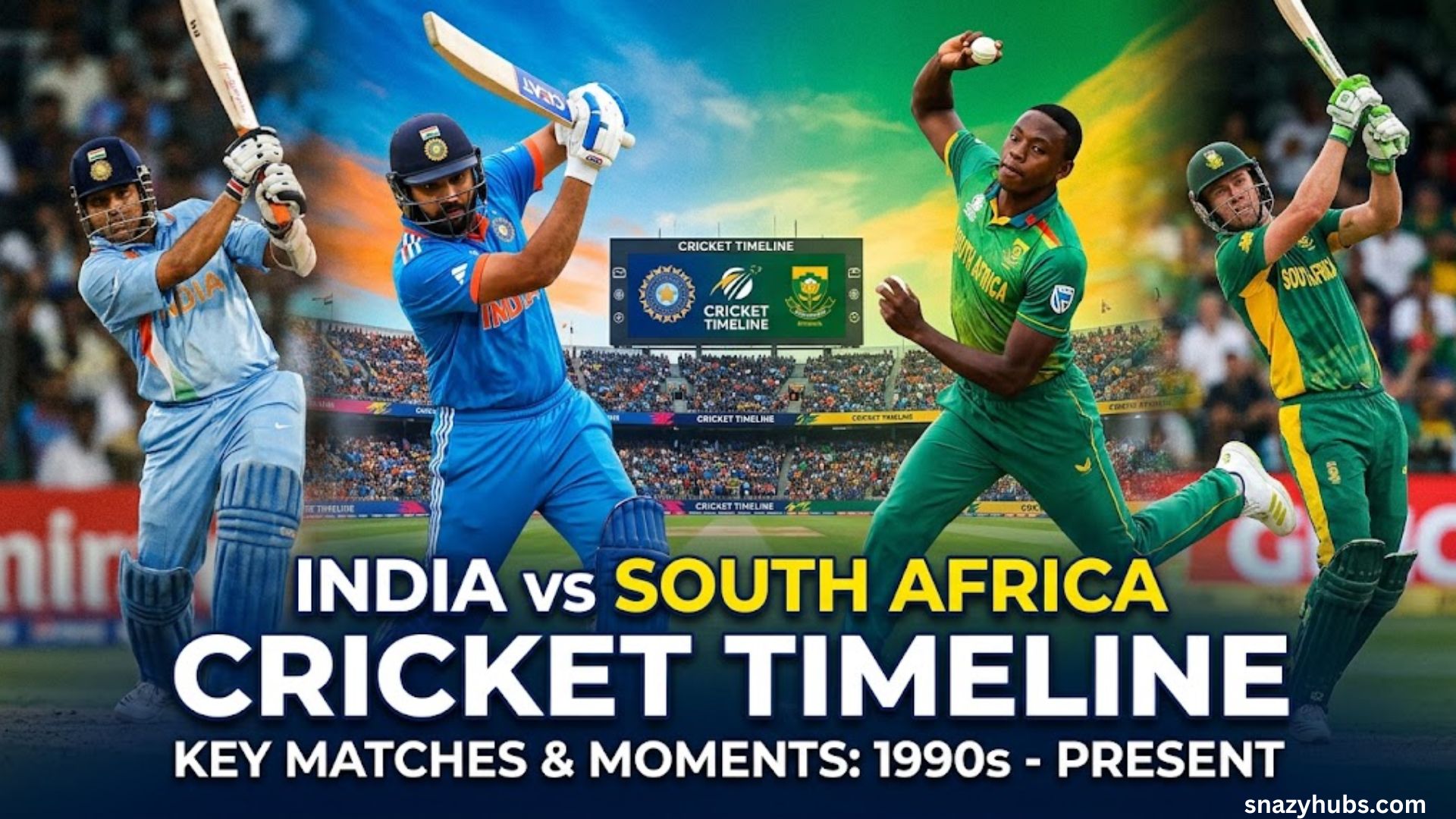
The India national cricket team vs South Africa national cricket team timeline tells a fascinating story of fierce competition, remarkable individual performances, and unforgettable international cricket. Since South Africa returned to international cricket in 1991, both teams have produced thrilling contests across Tests, One Day Internationals (ODIs), and Twenty20 Internationals (T20Is).
India have often relied on technically skilled batters, spin bowling, and an increasingly powerful pace attack. South Africa have traditionally brought fast bowling, athletic fielding, and aggressive batting to the contest. When these strengths collide, even a comfortable-looking lead can disappear in a few overs.
Some encounters have shaped the rivalry more than others. India’s 2018 Test victory at the Wanderers, the dramatic 2024 T20 World Cup final, South Africa’s dominant Test series win in India in 2025, and their T20 World Cup victory over India in February 2026 all deserve special attention.
This guide explores the rivalry chronologically, covering historic matches, series results, major tournament meetings, legendary players, and the statistics that help explain this competitive cricketing relationship.
India vs South Africa Cricket Rivalry at a Glance
The rivalry began in the early 1990s following South Africa’s return to international cricket after years of isolation. Their first ODI series against India in November 1991 marked an important step in the country’s reintegration into international competition.
Test cricket followed in 1992, adding a longer and more tactical dimension to the contest. T20Is arrived in 2006 and eventually created opportunities for new stars and dramatic finishes.
Here are the key facts:
- First ODI meeting: November 1991.
- First Test meeting: November 1992.
- First T20I meeting: December 2006.
- Major formats: Test cricket, ODIs, and T20Is.
- Major tournaments: ICC Men’s Cricket World Cup, ICC Men’s T20 World Cup, ICC Champions Trophy, and World Test Championship.
- Most famous recent encounter: India’s seven-run victory over South Africa in the 2024 T20 World Cup final.
The teams’ relationship has changed considerably over time. Early matches helped South Africa reestablish itself internationally. Later contests featured some of the world’s best batters and bowlers, while recent meetings have increasingly involved high-pressure ICC tournament games.
India National Cricket Team vs South Africa National Cricket Team Timeline: Key Years
The following timeline highlights major developments in the rivalry. It focuses on significant milestones rather than every bilateral fixture.
| Year | Major event | Why it matters |
|---|---|---|
| 1991 | South Africa returns to international cricket and plays an ODI series in India | Begins the modern bilateral rivalry |
| 1992 | First India–South Africa Test series | Establishes the rivalry in red-ball cricket |
| 2003 | India and South Africa meet in the Cricket World Cup | Adds major tournament pressure |
| 2006 | First T20I between the teams | Introduces the shortest international format |
| 2011 | India and South Africa meet at the Cricket World Cup | Highlights the strength of both ODI sides |
| 2015 | World Cup and bilateral encounters | Features another competitive period in limited-overs cricket |
| 2018 | India wins the third Test at Johannesburg | Demonstrates India’s growing competitiveness in South Africa |
| 2023 | India and South Africa meet at the ODI World Cup | Produces a significant tournament clash |
| 2024 | India wins the T20 World Cup final | Becomes a defining moment in the rivalry |
| 2025 | South Africa wins the Test series 2–0; India wins the ODI series 2–1 | Shows contrasting results across formats |
| 2026 | South Africa defeats India by 76 runs at the T20 World Cup | Adds another major chapter to the rivalry |
These milestones show why a single overall win-loss record cannot fully explain the relationship between the teams. Their performances vary depending on the format, venue, squad composition, and conditions.
The Early Years: India vs South Africa Cricket Timeline (1991–1999)
South Africa Returns to International Cricket in 1991
The rivalry began during a historic period for South African cricket. After decades of international isolation under apartheid, South Africa returned to the international game in 1991.
India became South Africa’s first international opponent after readmission. The teams met at Eden Gardens in Calcutta, now Kolkata, on November 10, 1991, in a landmark ODI.
India won that match by three wickets. Beyond the result, the fixture represented South Africa’s return to international competition and began a new chapter in cricket history.
The First Test Series in 1992–93
India toured South Africa in 1992–93 for a historic series. The teams played four Tests, and South Africa won the series 1–0. South Africa also won the seven-match ODI series 5–2.
The tour became known as the Friendship Tour. It carried significance beyond sport because it marked an important step in South Africa’s international reintegration.
The series also introduced innovations in officiating and television technology. Independent umpires and television replays for certain close decisions helped make the tour a notable moment in cricket administration.
The 1990s: South Africa Establishes Its Strength
South Africa developed a formidable ODI side during the decade. Players such as Allan Donald, Shaun Pollock, Gary Kirsten, and Hansie Cronje helped build a team known for disciplined bowling and energetic fielding.
India, meanwhile, had Sachin Tendulkar anchoring its batting. The two sides frequently tested each other’s weaknesses, particularly when India faced South Africa’s fast bowlers on bouncy pitches.
The decade established a pattern that continued for years: conditions could influence results as much as individual talent. South Africa’s seamers often enjoyed extra assistance at home, while India’s spinners became important weapons on slower Indian surfaces.
India vs South Africa Timeline: The 2000s
The 2003 Cricket World Cup
The 2003 ICC Men’s Cricket World Cup brought additional attention to the rivalry because South Africa hosted the tournament alongside Zimbabwe and Kenya.
India progressed to the final, while South Africa exited during the group stage. Their tournament campaigns reflected different outcomes despite both teams possessing experienced international players.
India benefited from strong performances by its top order and effective bowling combinations. South Africa had several world-class players but couldn’t maintain the consistency needed to reach the knockout rounds.
The First T20 International in 2006
The rivalry entered a new era on December 1, 2006, when India and South Africa played their first T20I in Johannesburg.
India won by six wickets, with Dinesh Karthik playing an important role in the chase. The match became India’s first-ever T20 International and marked the beginning of a format that would transform international cricket.
T20 cricket rewarded quick decision-making and aggressive batting. Players needed to score rapidly while preserving wickets and choosing bowling variations carefully.
The new format also created opportunities for finishers, specialist death bowlers, and flexible batting orders. Those tactical elements would become increasingly important in later India–South Africa encounters.
India vs South Africa Cricket History During 2010–2019
India’s Growing Test Competitiveness
During the 2010s, India became increasingly competitive in overseas Test cricket. Its pace attack improved, and the team developed more options for challenging South Africa in difficult conditions.
Virat Kohli emerged as one of India’s most influential batters. His aggressive approach and appetite for long innings helped shape India’s identity across formats.
South Africa remained a formidable opponent, with AB de Villiers, Hashim Amla, Dale Steyn, and Jacques Kallis among the players who defined the era.
The rivalry became a contest between India’s expanding bowling resources and South Africa’s established fast-bowling tradition.
India’s 2018 Test Victory at Johannesburg
India’s 2018 tour of South Africa produced an important moment in the rivalry. After losing the first two Tests, India won the third Test at the Wanderers in Johannesburg.
The pitch offered substantial bounce and movement, creating a difficult contest for both batting lineups. India eventually secured a 63-run victory, showing its ability to compete under demanding overseas conditions.
Although South Africa won the series 2–1, India’s final-match victory demonstrated that the team could challenge the hosts on their strongest terrain.
That result became part of a broader shift in India’s overseas ambitions. Rather than simply trying to survive fast-bowling conditions, India increasingly arrived with the pace attack needed to take 20 wickets.
India vs South Africa Timeline: Memorable Matches From 2020 to 2024
The 2023 Cricket World Cup Meeting
India and South Africa met during the league stage of the 2023 ICC Men’s Cricket World Cup in Kolkata on November 5.
India scored 326/5 and dismissed South Africa for 83, winning by 243 runs. Virat Kohli scored an unbeaten century, while Ravindra Jadeja took five wickets.
The match highlighted India’s ability to combine batting stability with relentless bowling pressure. South Africa had enjoyed an excellent tournament up to that point, but India’s performance left little room for recovery.
India’s Cape Town Test Victory in January 2024
The second Test of India’s 2023–24 tour of South Africa took place at Newlands in Cape Town on January 3–4, 2024.
India won by seven wickets in a match that finished in less than two days. South Africa made 55 in its first innings, while India took a first-innings lead before completing the chase.
The result was remarkable because Test matches usually require several days. Here, movement off the pitch and disciplined bowling caused both teams to lose wickets quickly.
The victory helped India draw the two-match series 1–1. It also reinforced an important lesson: even experienced batting lineups can struggle when conditions strongly favor bowlers.
The 2024 T20 World Cup Final: India’s Seven-Run Victory
The 2024 ICC Men’s T20 World Cup final became one of the most memorable matches in the entire rivalry. Both teams reached the final unbeaten, setting up a contest between India’s championship experience and South Africa’s pursuit of its first senior men’s T20 World Cup title.
India batted first and scored 176/7. Virat Kohli led the innings with 76 runs from 59 balls, giving India a competitive total despite losing wickets at important moments.
South Africa responded strongly. Heinrich Klaasen attacked India’s bowlers and threatened to take control of the chase, while Quinton de Kock contributed valuable runs.
India needed a remarkable finish. Hardik Pandya dismissed Klaasen, and Jasprit Bumrah delivered crucial overs under pressure. Suryakumar Yadav’s boundary catch to dismiss David Miller became another defining moment.
South Africa finished on 169/8, giving India a seven-run victory. The result secured India’s second men’s T20 World Cup title and delivered a painful near-miss for South Africa.
Match summary
| Team | Score |
|---|---|
| India | 176/7 |
| South Africa | 169/8 |
| Result | India won by 7 runs |
| India’s leading batter | Virat Kohli — 76 |
| Tournament | ICC Men’s T20 World Cup 2024 |
This final remains central to the India national cricket team vs South Africa national cricket team timeline because it combined a major trophy, a dramatic finish, and outstanding individual performances.
India vs South Africa Timeline: The Major Results of 2025
The 2025 season delivered contrasting outcomes in Test and ODI cricket. South Africa dominated the Test series, while India responded strongly in the ODI format.
South Africa Wins the Test Series 2–0
South Africa toured India for a two-match Test series in November 2025. The visitors won both matches, exposing India’s difficulties against a disciplined bowling attack.
The first Test took place in Kolkata, where South Africa won by 30 runs. The low-scoring contest highlighted the importance of patience, shot selection, and bowling accuracy on a challenging surface.
The second Test in Guwahati produced an even more striking result. South Africa won by 408 runs, handing India its heaviest defeat by runs in Test cricket.
The margin made the result historically significant. South Africa combined substantial batting contributions with effective spin bowling to control the match from the middle stages onward.
The series also demonstrated why home advantage cannot guarantee victory. Indian conditions often favor spin, but visiting teams can succeed when they adapt to the pitch and execute their plans consistently.
India Wins the ODI Series 2–1
India recovered in the three-match ODI series, winning 2–1.
Virat Kohli starred in the opening match at Ranchi on November 30, scoring 135 from 120 balls. India posted 349/8 and defeated South Africa by 17 runs.
Kohli’s innings showed how an experienced batter can balance calculated aggression with control. He built his innings before accelerating, giving India a strong platform for the final overs.
India then won the series with another strong batting display in the deciding match at Visakhapatnam on December 6. The result reinforced the difference between formats: the skills required to win a Test series aren’t identical to those needed for ODI success.
The 2025 T20I Series
India and South Africa also played a five-match T20I series in December 2025.
For a complete article, include every match’s date, venue, score, and outcome from the official scorecards. The series should be recorded separately from the Test and ODI results because each format measures different strengths.
A useful series table would look like this:
| Format | Series result | Main takeaway |
|---|---|---|
| Tests | South Africa won 2–0 | South Africa controlled the longer format |
| ODIs | India won 2–1 | India responded with stronger limited-overs performances |
| T20Is | Verify final series result against official scorecards | Adds another chapter to the shortest-format rivalry |
India vs South Africa Timeline: The 2026 T20 World Cup Clash
February 22, 2026 · Narendra Modi Stadium, Ahmedabad
South Africa delivered a commanding performance against India in the Super Eight stage of the 2026 ICC Men’s T20 World Cup.
South Africa scored 187/7 in 20 overs, recovered from an early collapse, and bowled India out for 111 in 18.5 overs. The Proteas won by 76 runs, ending India’s 12-match winning streak at the T20 World Cup.
David Miller Leads South Africa’s Recovery
South Africa struggled early and fell to 20/3. David Miller responded with an aggressive 63 from 35 balls, stabilizing the innings and increasing the scoring rate.
His contribution changed the match’s direction. Instead of allowing India to dominate the middle overs, South Africa built a total that demanded a difficult chase.
The innings also demonstrated the value of experience in T20 cricket. When early wickets fall, a batter must rebuild without losing the ability to attack.
South Africa’s Bowlers Dominate the Chase
Marco Jansen took four wickets for 22 runs, while Keshav Maharaj claimed three wickets for 24 runs.
India never established a sustained partnership capable of bringing the required rate under control. South Africa’s bowlers varied their pace, maintained pressure, and exploited India’s mistakes.
The result mattered beyond the points table. It showed that South Africa could defeat India convincingly on a major tournament stage, even after the disappointment of the 2024 final.
| Match detail | Result |
|---|---|
| South Africa | 187/7 |
| India | 111 all out |
| Winning margin | South Africa won by 76 runs |
| David Miller | 63 off 35 balls |
| Marco Jansen | 4/22 |
| Keshav Maharaj | 3/24 |
For the latest tournament records, consult the official ICC 2026 match page.
India vs South Africa Head-to-Head Record by Format
Head-to-head statistics help readers compare the teams across different conditions and eras. However, totals change whenever the teams play another international match, so figures should always include an update date.
The table below summarizes the historical pattern without presenting unverified current totals as definitive.
| Format | Rivalry began | Key characteristic |
|---|---|---|
| Test cricket | 1992 | Patience, bowling depth, and adaptation to pitch conditions |
| ODI cricket | 1991 | Batting partnerships, middle-over control, and death bowling |
| T20I cricket | 2006 | Power-hitting, tactical matchups, and execution under pressure |
Test Cricket: A Contest of Patience and Conditions
Test cricket places the greatest demands on concentration and bowling depth. South Africa have traditionally benefited from seam movement and bounce at home, while India have often relied on spin and batting depth on home pitches.
The 2023–24 series ended 1–1, illustrating how quickly momentum can shift between venues. South Africa won the first Test in Centurion, while India responded with victory in Cape Town.
The 2025 series then produced a 2–0 South African win in India. These results show why historic performance in one country doesn’t guarantee success on the next tour.
ODI Cricket: Consistency Across Fifty Overs
ODI matches require teams to manage three phases: the powerplay, the middle overs, and the final overs.
India’s 2025 series victory demonstrated the value of a strong top order and a deep batting lineup. South Africa’s ability to post competitive totals has often depended on powerful middle-order batters and effective pace bowling.
In World Cup matches, the pressure increases because one defeat can affect qualification or eliminate a team entirely.
T20I Cricket: Fine Margins and Fast Momentum Shifts
T20 cricket often turns on a handful of deliveries. A missed catch, a successful bowling change, or a quick partnership can transform the result.
The 2024 final showed India’s ability to defend a total under extreme pressure. The 2026 Super Eight match showed South Africa’s ability to recover from early wickets and then dominate with the ball.
Together, these matches illustrate why T20I head-to-head records should be read alongside individual match reports rather than treated as a complete measure of a team’s quality.
Key Players Who Shaped the India vs South Africa Rivalry
Great rivalries aren’t built by scorecards alone. They also depend on players who repeatedly deliver when the pressure rises.
Indian Cricket Legends
Sachin Tendulkar
Tendulkar helped define India’s batting identity during the early years of the rivalry. His technique against pace and spin made him a central figure in India’s international campaigns throughout the 1990s and 2000s.
Virat Kohli
Kohli has produced major performances across formats. His 76 in the 2024 T20 World Cup final and 135 in the first ODI against South Africa in November 2025 stand out as defining contributions.
Jasprit Bumrah
Bumrah’s accuracy, unusual bowling action, and ability to deliver under pressure have made him a major weapon against South Africa. His performance in the 2024 T20 World Cup final helped India defend a narrow total.
Rahul Dravid
Dravid brought patience and technical discipline to India’s batting. His era coincided with some of the rivalry’s formative Test and ODI encounters.
South African Cricket Legends
Jacques Kallis
Kallis combined dependable batting with effective seam bowling. His all-around ability gave South Africa flexibility in both Test and limited-overs cricket.
AB de Villiers
De Villiers became famous for inventive stroke play and rapid scoring. He could change an ODI or T20I in a short burst of attacking batting.
Dale Steyn
Steyn’s pace and ability to move the ball made him one of South Africa’s most dangerous Test bowlers. He frequently challenged India’s top order in demanding conditions.
David Miller
Miller is known for his power-hitting and finishing ability. His 63 off 35 balls against India in the 2026 T20 World Cup helped South Africa recover from an early collapse.
Other important contributors include Rohit Sharma, Rahul Dravid, Ravindra Jadeja, Quinton de Kock, Hashim Amla, Kagiso Rabada, and Marco Jansen. Their performances across different eras demonstrate the depth of talent on both sides.
What Makes the India vs South Africa Rivalry So Competitive?
Several factors explain why the teams have produced such varied results across decades.
Different Playing Conditions
South African pitches often offer bounce and seam movement. Indian pitches can provide more assistance to spinners, although conditions vary considerably from ground to ground.
A batter who dominates on a slow surface may face a very different challenge on a fast pitch. Teams must adjust their techniques, bowling plans, and selection decisions accordingly.
Strong Bowling Attacks
Both countries have developed excellent fast bowlers. India have strengthened their overseas pace attack over time, while South Africa have maintained a tradition of producing quick, aggressive seamers.
Spin also plays an important role, especially in India. Bowlers who vary their pace and length can create pressure even when the pitch offers little assistance.
Pressure in ICC Tournaments
Bilateral series allow teams to recover from an individual defeat. Knockout matches and tournament stages leave much less room for error.
The 2024 T20 World Cup final demonstrated India’s composure under pressure. South Africa’s 2026 victory showed how effectively the team could execute a plan against the defending champions.
Tactical Changes Across Formats
Test cricket rewards patience and sustained pressure. ODIs demand careful management of innings and resources. T20Is require rapid decisions and precise execution.
That distinction explains why one team can dominate a Test series but lose the ODI series that follows. The rivalry is not simply about which side has better players; it’s also about which side adapts more effectively to the format.
Frequently Asked Questions
When Did India and South Africa First Play Against Each Other?
India and South Africa played their first international match against each other on November 10, 1991, in an ODI at Eden Gardens in Calcutta, now Kolkata. India won by three wickets.
Who Won the 2024 India vs South Africa T20 World Cup Final?
India won by seven runs on June 29, 2024. India scored 176/7, while South Africa finished on 169/8 at Kensington Oval in Barbados.
What Happened in the India vs South Africa T20 World Cup Match in 2026?
South Africa defeated India by 76 runs on February 22, 2026. South Africa scored 187/7 before bowling India out for 111 in Ahmedabad.
How Did the 2025 India vs South Africa Test Series End?
South Africa won the two-match Test series 2–0. They won the first Test in Kolkata by 30 runs and the second in Guwahati by 408 runs.
Who Won the India vs South Africa ODI Series in 2025?
India won the three-match ODI series 2–1. Virat Kohli scored 135 in the first ODI at Ranchi as India began the series with a 17-run victory.
Which Players Have Made the Biggest Impact on This Rivalry?
Sachin Tendulkar, Virat Kohli, Rahul Dravid, Jacques Kallis, AB de Villiers, and Dale Steyn have all played important roles in different eras. More recent highlights include Jasprit Bumrah’s bowling and David Miller’s power-hitting.
Where Can I Find Official India vs South Africa Match Results?
Visit the ICC official website for tournament results and match reports. You can also consult ESPNcricinfo for historical scorecards, series archives, and player statistics.
Conclusion: The India National Cricket Team vs South Africa National Cricket Team Timeline Continues
The India national cricket team vs South Africa national cricket team timeline reflects more than three decades of international competition. It began with South Africa’s return to cricket in 1991 and grew into a rivalry featuring world-class players, historic Test victories, and dramatic World Cup encounters.
India’s seven-run victory in the 2024 T20 World Cup final remains one of its defining moments. South Africa’s 2–0 Test series win in India in 2025 demonstrated its ability to dominate in difficult conditions. The Proteas then reinforced their credentials with a commanding victory over India at the 2026 T20 World Cup.
Each format reveals a different side of the contest. Tests reward patience and bowling depth, ODIs demand consistency, and T20Is often turn on a handful of deliveries.
As new players enter both teams, the rivalry will continue to evolve. Future tours and ICC tournaments will add fresh results to a history already filled with memorable performances, narrow finishes, and major turning points.
The best way to understand this rivalry is to look beyond the final scores. Its real story lies in how both teams respond to pressure, adapt to conditions, and find new ways to compete at the highest level.
