

K Meaning in Text
Have you ever sent a message and received nothing more than “K” in reply?
That single letter can leave you wondering what the other person really means. Are they simply acknowledging your message? Are they annoyed? Did you say something wrong? Or are they just in a hurry?
The truth is that K Meaning in Text depends almost entirely on context, tone, relationship, and the conversation itself. While “K” originally came from shortening “OK,” its meaning has evolved with texting culture. Today, it can express agreement, indifference, frustration, or simply a quick acknowledgment.
In this complete guide, you’ll learn exactly what K Meaning in Text is, why people use it, how it changes across different platforms, and how you should respond in different situations.
What Does “K” Mean in Text?
The most common K Meaning in Text is simply:
“K” means “OK.”
People often use it as a quick way to acknowledge a message without typing the full word.
Instead of writing:
- OK
- Okay
- Alright
Someone simply types:
K
Most of the time, it communicates one of these ideas:
- I understand.
- I agree.
- I got your message.
- That’s fine.
- Sounds good.
- Conversation acknowledged.
However, the emotional tone behind “K” can change depending on who sends it and when they send it.
What “K” Usually Communicates
| Meaning | Typical Tone | Example |
|---|---|---|
| Agreement | Neutral | “Meet at 7?” → “K” |
| Confirmation | Neutral | “I’ll call later.” → “K” |
| Acknowledgment | Neutral | “Package arrived.” → “K” |
| Conversation ending | Brief | “Talk tomorrow.” → “K” |
| Mild frustration | Cold | “Whatever you think.” → “K” |
Quick Examples
Friend
Friend: “Movie starts at 8.”
You: “K”
Meaning: Sounds good.
Family
Mom: “Dinner is ready.”
You: “K”
Meaning: I’m coming.
Work
Manager: “Please send the report before noon.”
Employee: “K”
Meaning: Message received.
Although “K” works here, “Got it” or “Will do” usually sounds more professional.
Where Did “K” Come From?
The history of “K” goes back much further than smartphones.
The Evolution from “Okay” to “OK”
The word OK became popular in the United States during the 1800s after newspapers used humorous abbreviations. Over time, “OK” became one of the world’s most recognized words.
When mobile phones became common, people wanted even faster ways to type.
Typing:
Okay
became
OK
Eventually, it became simply:
K
Why Texting Changed Communication
Early text messaging limited users to 160 characters per message. Every character mattered.
As a result, people shortened almost everything:
- You → U
- Before → B4
- Great → Gr8
- Okay → K
Even though modern messaging apps no longer have strict character limits, these shortcuts remain popular.
Why “K” Became Popular
Several factors helped “K” become common:
- Faster typing
- Mobile keyboards
- Instant messaging
- Busy lifestyles
- Habit formed through years of texting
Today, millions of people use “K” every day without thinking twice.
What Does “K” Really Mean?
Although the basic definition is “OK,” the actual meaning changes with the situation.
“I Understand”
Sometimes “K” simply means:
“I understand.”
Example
Person A:
“The meeting moved to 3 PM.”
Person B:
“K”
No hidden meaning exists.
“I Agree”
Sometimes “K” expresses agreement.
Example
Friend:
“Let’s order pizza.”
Reply:
“K”
Meaning:
“That works.”
“Conversation Over”
Sometimes people use “K” to politely end a conversation.
Example:
“See you tomorrow.”
Reply:
“K”
The discussion naturally ends.
“I’m Busy”
People often send “K” because they’re occupied.
Imagine someone driving, shopping, or working. They acknowledge your message with one letter and plan to respond later.
“I Don’t Want to Keep Talking”
Sometimes “K” signals that someone doesn’t want to continue the discussion.
Instead of explaining why, they end the conversation quickly.
“I’m Annoyed”
Context matters.
If a conversation has become tense, “K” may suggest irritation.
Example:
Person A:
“You never listen.”
Person B:
“K”
Here, the reply may sound dismissive.
“I’m Upset”
In emotional conversations, “K” sometimes communicates disappointment more than anger.
Instead of arguing further, someone chooses the shortest possible response.
Why Does “K” Sometimes Feel Rude?
Many people assume “K” sounds cold. That reaction isn’t random.
Several psychological factors explain why.
Missing Emotional Cues
Text messages lack:
- Facial expressions
- Voice tone
- Body language
- Eye contact
Because these cues disappear, readers naturally interpret meaning themselves.
Short Replies Feel Colder
Longer responses often feel warmer.
Compare these replies:
- Okay!
- Sounds good!
- Sure 😊
Now compare them with:
K
The second version feels much less expressive.
Expectations in Digital Communication
People expect friendly replies in casual chats.
When someone suddenly switches from:
“Sounds great!”
to
“K”
the change in tone becomes noticeable.
The Psychology Behind One-Letter Replies
Researchers studying digital communication often note that people naturally fill in missing emotional information. This tendency is called negative interpretation bias.
When very little information exists, readers often assume a negative emotion—even if none was intended.
That’s why one tiny letter can sometimes create unnecessary misunderstandings.
How Context Changes the Meaning of “K”
The same reply can mean completely different things depending on who sends it.
| Relationship | Most Likely Meaning |
|---|---|
| Friend | Okay |
| Parent | Acknowledged |
| Romantic partner | Depends on mood |
| Coworker | Understood |
| Boss | Message received |
| Stranger | Neutral |
Friends
Friends usually use “K” casually.
Example:
“Meet outside?”
“K”
Nothing unusual.
Family
Parents often text briefly.
“Pick up milk.”
“K”
Simple acknowledgment.
Romantic Partners
Relationships create more emotional interpretation.
If your partner normally writes paragraphs but suddenly replies with “K,” you may wonder if something is wrong.
Always consider the rest of the conversation before making assumptions.
Coworkers
“K” usually means:
- Understood
- Noted
- Thanks
Still, longer replies often appear more professional.
Bosses and Clients
A better response includes:
- Understood
- Will do
- Absolutely
- Thanks
These replies sound more engaged.
What Does “K” Mean on Different Platforms?
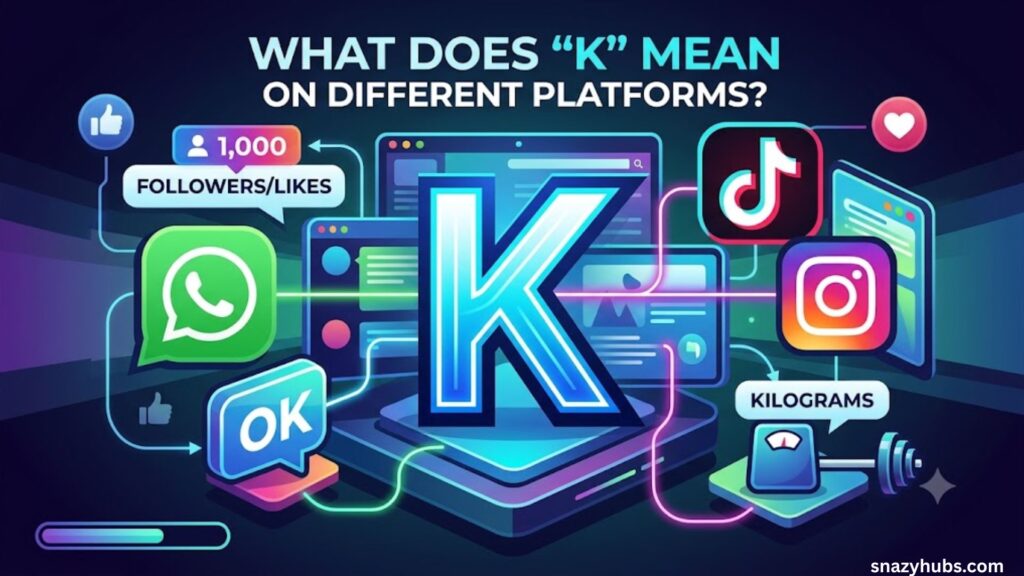
The meaning remains mostly consistent, although communication styles vary.
| Platform | Typical Meaning |
|---|---|
| SMS | OK |
| Quick acknowledgment | |
| iMessage | Neutral |
| Instagram DM | Casual reply |
| Snapchat | Fast response |
| Discord | Conversation moving quickly |
| TikTok Messages | Casual agreement |
| Reddit Chat | Neutral acknowledgment |
People often use “K” during everyday conversations because replies happen quickly.
Instagram DMs
“K” commonly acknowledges plans or reactions.
Snapchat
Fast replies make one-letter messages normal.
Discord
Gaming communities often prefer short messages to keep conversations moving.
“K” in Dating and Relationships
Dating introduces emotion into every message.
That makes “K” one of the most misunderstood replies.
When “K” Is Normal
- They’re busy.
- They’re multitasking.
- They already answered your question.
When It Might Signal Frustration
If the conversation already feels tense, “K” may indicate annoyance.
Example:
Person A:
“We need to talk.”
Person B:
“K”
The response feels emotionally distant.
When You’re Probably Overthinking It
Many people naturally text in short bursts.
Some simply dislike typing.
Don’t assume “K” means someone has lost interest without looking at the bigger picture.
“K” During Arguments and Difficult Conversations
Arguments change how messages are interpreted.
Passive Agreement
Sometimes someone no longer wants to argue.
“K” means:
“Fine.”
Silent Disagreement
Other times, “K” means:
“I don’t agree, but I’m done talking.”
Ending the Discussion
People often use “K” to signal the conversation has ended.
That doesn’t necessarily mean they’re angry forever.
K vs Similar Texting Replies
| Expression | Tone | Formality | Common Meaning |
|---|---|---|---|
| K | Brief | Low | OK |
| OK | Neutral | Medium | Agreement |
| Okay | Friendly | Medium | Acceptance |
| KK | Casual | Low | Okay, sounds good |
| Got it | Professional | High | Understood |
| Sure | Friendly | Medium | Agreement |
| 👍 | Casual | Low | Confirmed |
| Alright | Warm | Medium | Acceptance |
K vs OK
“OK” feels slightly friendlier than “K.”
K vs Okay
“Okay” sounds warmer and more conversational.
K vs KK
“KK” usually sounds happier than a single “K.”
K vs Got It
Excellent for work conversations.
How Different Generations Use “K”
Communication styles vary by age.
| Generation | Typical Interpretation |
|---|---|
| Gen Z | Can sound cold |
| Millennials | Usually neutral |
| Gen X | Often practical |
| Older adults | Simply means OK |
This difference explains why younger users sometimes read more emotion into “K” than older users do.
Common Situations Where You’ll See “K”
People use “K” every day in many situations.
Making Plans
“Dinner at 6?”
“K”
School Conversations
“Homework is due Friday.”
“K”
Workplace Messages
“Meeting starts at 10.”
“K”
Gaming Chats
Quick communication matters during games.
Players often reply with:
K
instead of longer messages.
Group Chats
“K” acknowledges information without interrupting the conversation.
When Should You Avoid Replying with “K”?
Although useful, “K” isn’t appropriate everywhere.
Avoid it during:
- Job interviews
- Business emails
- Customer support
- Relationship conflicts
- Serious discussions
Instead, write:
- Understood.
- Sounds good.
- Thanks.
- I’ll take care of it.
- Absolutely.
Better Alternatives to “K”
| Instead of “K” | Try This |
|---|---|
| K | OK |
| K | Sounds good |
| K | Got it |
| K | Will do |
| K | Understood |
| K | Absolutely |
| K | Sure |
| K | Thanks |
| K | No problem |
These alternatives sound warmer while remaining concise.
Common Misconceptions About “K”
“K” Always Means Someone Is Angry
False.
Most people simply mean “OK.”
Everyone Thinks “K” Is Rude
False.
Interpretations vary widely.
“K” Always Ends a Conversation
Not always.
Many conversations continue naturally afterward.
Only Younger People Use It
False.
People of every age use “K.”
One Letter Always Has One Meaning
Definitely false.
Context determines everything.
Real Chat Examples Showing How “K” Is Used
Friendly Conversation
Alex:
“Want coffee later?”
Jordan:
“K”
Meaning: Agreement.
Family Chat
Dad:
“We’ll leave at 9.”
You:
“K”
Meaning: Understood.
Workplace Chat
Manager:
“Please review the document.”
Employee:
“Got it.”
This works better than “K.”
Dating Conversation
Taylor:
“See you tonight?”
Morgan:
“K 😊”
The emoji completely changes the tone.
Argument
Person A:
“Whatever.”
Person B:
“K”
Meaning:
The discussion has ended for now.
How to Respond When Someone Sends “K”
If you’re unsure what someone means, don’t jump to conclusions.
Casual Conversation
Continue naturally.
Example:
“See you later!”
If the Tone Feels Cold
Ask politely.
“Everything okay?”
If They’re Upset
Give them space before continuing the conversation.
Professional Conversation
Simply move forward with the task.
No need to overanalyze.
Dating Situation
Look at:
- Previous messages
- Recent behavior
- Conversation history
One letter rarely tells the whole story.
Is “K” Positive, Negative, or Neutral?
| Situation | Meaning | Tone | Should You Worry? |
|---|---|---|---|
| Friend | OK | Neutral | No |
| Parent | Understood | Neutral | No |
| Coworker | Acknowledged | Professional | No |
| Argument | Possible frustration | Negative | Maybe |
| Dating | Depends on context | Mixed | Sometimes |
| Group Chat | Confirmation | Neutral | No |
Quick Cheat Sheet: K Meaning in Text
| Situation | Meaning |
|---|---|
| Friend | Sounds good |
| Parent | Understood |
| Boss | Acknowledged |
| Coworker | Received |
| Partner | Depends on context |
| Stranger | Neutral |
| Gaming | Ready |
| Social Media | Casual agreement |
Quick Tip: Never judge the meaning of “K” by itself. Always read it alongside the conversation, the relationship, and the person’s usual texting style.
Frequently Asked Questions About K Meaning in Text
What does K mean in text?
The most common K Meaning in Text is simply “OK.” It acknowledges a message, confirms understanding, or shows agreement.
Is replying with K rude?
Not necessarily. In casual conversations, it’s usually harmless. During emotional discussions, however, it may seem brief or distant.
What does K mean from a girl?
There isn’t a gender-specific meaning. Like anyone else, she may use it to mean “OK,” acknowledge your message, or end a conversation. The surrounding context matters far more than the sender’s gender.
What does K mean from a guy?
Just as with anyone else, “K” most often means “OK” or “I got your message.” Don’t assume it signals annoyance unless the rest of the conversation suggests that.
Does K mean someone is mad?
Sometimes, but not always. A single-letter reply can reflect frustration during an argument, yet it can also mean the person is busy or simply prefers brief messages.
Is K different from OK?
Yes. Both share the same core meaning, but “OK” generally feels a bit warmer and more complete. “K” often comes across as quicker and more abrupt.
Why do people text only K?
People use it because it’s fast, convenient, and familiar. Some also prefer short replies when multitasking or when no further discussion is needed.
What should I reply to K?
If the conversation naturally ends, no reply is necessary. If you need more information, ask a clear follow-up question or continue the discussion as usual.
What does KK mean in text?
“KK” usually means “Okay” with a friendlier tone. Many people use it to sound more positive than a single “K.”
Is K acceptable in professional communication?
It depends on the workplace. While some teams use it internally, replies like “Understood,” “Will do,” or “Got it” generally sound more professional and leave a better impression.
Final Thoughts
Understanding K Meaning in Text is less about the letter itself and more about the context surrounding it. Although “K” began as a simple abbreviation for “OK,” it now carries different shades of meaning depending on the relationship, the platform, and the conversation.
Most of the time, “K” simply means “I understand” or “Okay.” In some situations, especially during disagreements or emotionally charged conversations, it can feel distant or dismissive. Even then, it’s wise to consider the person’s usual texting habits before drawing conclusions.
The next time you receive a one-letter reply, resist the urge to overanalyze it. Read the conversation as a whole, pay attention to the broader context, and remember that digital communication often lacks the facial expressions and tone of voice that help us understand each other in person. One small letter rarely tells the entire story.
