

If you’ve ever scrolled through Reddit, a group chat, or a gaming Discord server and spotted the letters “OP,” you’ve probably paused for a second. Is it a compliment? A tag? Some kind of inside joke? You’re not imagining things. OP is one of the most common pieces of internet slang out there, and it shows up in wildly different contexts with two totally different meanings.
This guide breaks down everything you need to know about OP meaning in text, from where it came from to how people use it today. By the end, you’ll never second-guess yourself the next time someone drops “OP” into a conversation.
Quick Answer
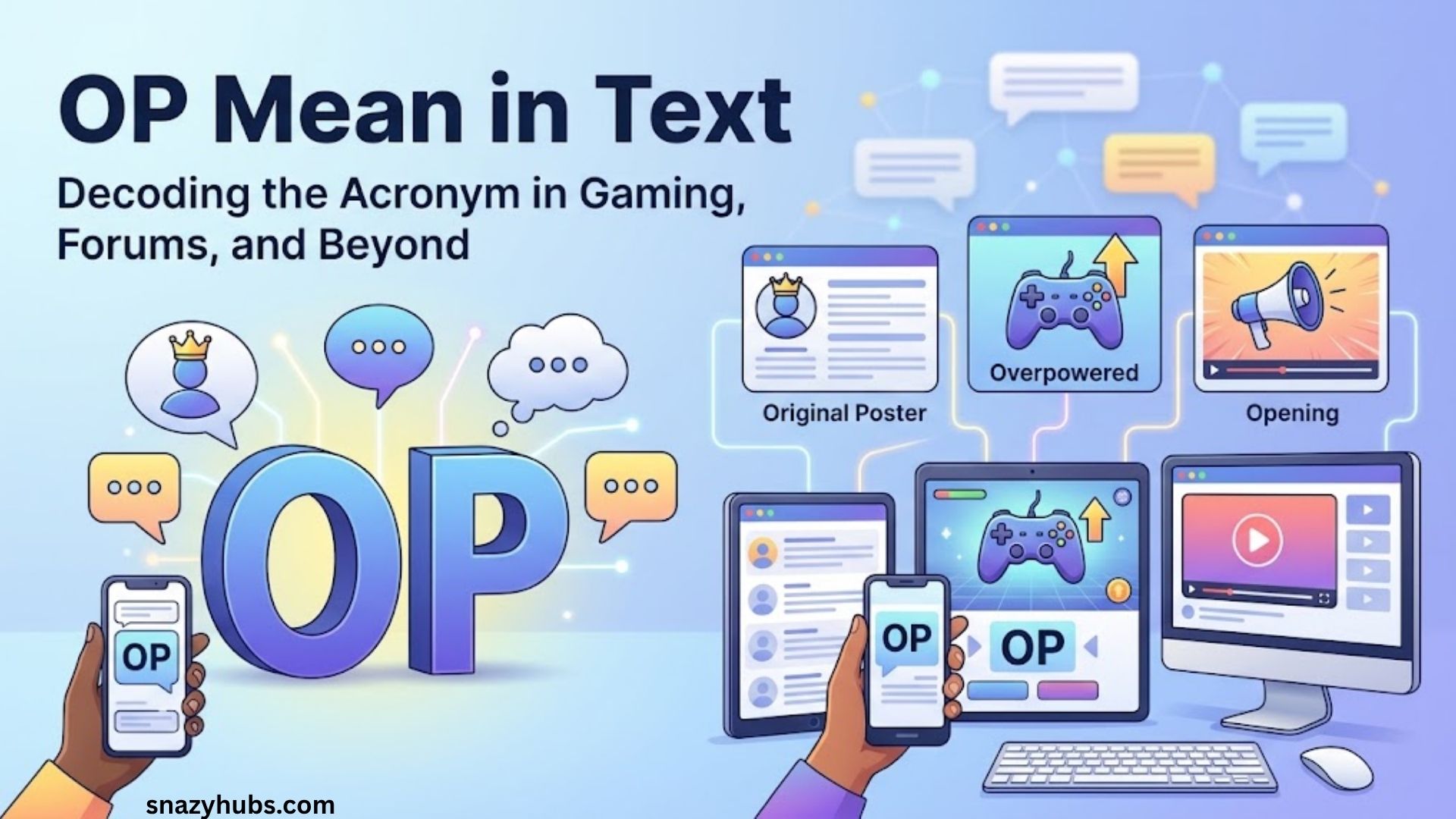
OP has two primary meanings depending on where you see it. On forums, Reddit, and most online discussions, OP stands for “Original Poster”, referring to the person who started a thread or post. In gaming and casual slang, OP means “Overpowered,” describing something (usually a weapon, character, or strategy) that’s unfairly strong.
Both meanings are widely used in 2026, and figuring out which one applies just takes a little context. We’ll walk through exactly how to tell them apart in a few minutes.
What Does OP Stand For?
OP is an abbreviation, and like a lot of internet slang, it packs more than one meaning into two letters. Here’s the breakdown.
Original Poster
This is the OP definition most people encounter first. In any online discussion, whether it’s Reddit, a forum, or a comment thread, someone has to start it. That person is the “original poster,” and everyone else just refers to them as OP going forward. It’s shorthand that saves people from typing out a username over and over.
You’ll see phrases like:
- “OP never responded to any of the questions.”
- “As OP mentioned in the edit, the issue got fixed.”
- “OP, can you post an update?”
Overpowered
The second major OP meaning in gaming circles is “overpowered.” This one describes anything in a game, whether it’s a weapon, a character, an ability, or even a strategy, that gives players a huge and often unfair advantage. If a weapon in a shooter deals way more damage than it should, players will call it OP almost immediately.
Examples of this usage:
- “That new sniper rifle is so OP, they need to nerf it.”
- “This character’s ultimate ability feels OP compared to everyone else’s.”
- “The devs patched the bug because it made low-level items OP.”
Less Common Uses Worth Knowing
Occasionally, people use OP to mean “on point,” though this is rare and mostly regional. You might also see “OP” used loosely to mean “original post” rather than “original poster,” which technically refers to the content itself rather than the person. The distinction rarely matters in casual conversation, but purists on forums like Reddit will sometimes correct you if you mix them up.
Where Did OP Come From?
Understanding the history and origin of OP slang helps explain why the term stuck around for so long, and why it split into two separate meanings that rarely overlap.
Early Internet Forums
The “Original Poster” meaning goes back to the earliest days of threaded online discussion. Bulletin board systems (BBS) and Usenet groups in the 1980s and 1990s needed a simple way for users to reference whoever had kicked off a thread. As forums grew larger through the 2000s, with sites like 4chan, phpBB-based communities, and early Reddit, “OP” became the standard shorthand. It was fast to type, unambiguous within a thread, and didn’t require remembering usernames.
Reddit, in particular, helped cement this meaning into mainstream internet culture. The platform even builds an “OP” tag directly into the interface, automatically labeling the person who submitted a post whenever they comment in their own thread. That built-in feature turned OP from niche forum jargon into something hundreds of millions of people see every single day.
Gaming Culture Influence
The “Overpowered” meaning developed on a completely separate track. It grew out of competitive gaming and game design discussions, where players needed language to talk about balance. When a game element performs far better than its competitors, without a fair trade-off, players call it overpowered. Over time, that got shortened to OP for speed, the same way gamers shorten almost everything (“GG,” “AFK,” “OP” itself all fit this pattern).
Here’s the interesting part: these two meanings didn’t evolve from one another. They’re essentially two unrelated slang terms that happen to share the same two letters. That coincidence is exactly why context matters so much when you’re trying to figure out what someone means.
OP Meaning by Platform
Different platforms lean toward different meanings, so knowing where you’re reading OP can tell you a lot before you even look at the sentence around it.
| Platform | Typical OP Meaning | Notes |
|---|---|---|
| Original Poster | Built into the platform as an automatic tag | |
| Forums (general) | Original Poster | Classic, long-standing usage |
| Discord (gaming servers) | Overpowered | Common in balance discussions |
| Discord (general chat) | Original Poster | Depends heavily on server topic |
| Twitter/X | Original Poster | Looser usage, sometimes just means “whoever posted this” |
| Instagram comments | Original Poster | Less common overall, but same meaning when used |
| Gaming forums and patch notes | Overpowered | Frequently used by developers and players alike |
On Reddit, OP meaning is about as unambiguous as internet slang gets. The platform automatically tags the original poster’s username with “OP” whenever they comment inside their own post. If you ask a question on Reddit and someone answers, then you reply back, your reply will show up labeled OP so other users know it came from the person who started the thread. It’s one of the clearest real-world examples of what does OP mean on Reddit specifically.
Twitter/X and Instagram
Social media platforms use OP a bit more loosely. Since there’s no built-in tag like Reddit’s, people manually type “OP” when referring back to whoever posted the original tweet or image, especially in quote-tweets or comment threads where the conversation has drifted from the original post. OP meaning in social media almost always defaults to “original poster” here, since overpowered rarely comes up outside gaming-specific accounts.
Discord and Gaming Chats
This is where things flip. OP meaning in gaming chats leans heavily toward “overpowered,” especially in servers built around specific games. Players debate patch notes, argue about tier lists, and complain about balance changes constantly, and OP is the fastest way to describe something that’s too strong.
OP in Gaming: Overpowered Explained
Since OP meaning in gaming is such a huge part of how the term gets used today, it’s worth digging deeper into what actually makes something “OP” and how players talk about it.
What Makes Something OP
Game designers try to balance every weapon, character, and mechanic so that no single choice dominates. When that balance breaks, whether from a coding oversight, a rushed update, or simply an underestimated combination, players notice fast. A weapon that kills in one hit when others take three, a character whose abilities have no real downside, or a strategy that counters everything else in the game all get labeled OP.
Overpowered as Both a Complaint and a Compliment
Here’s something a lot of guides miss: OP isn’t always negative. Players use it both ways.
- As a complaint: “This weapon is so OP, it ruins the whole match.”
- As a compliment: “Dude, that combo you pulled off was OP.”
The tone and context decide whether OP is criticism or praise. A player frustrated by losing to an unbalanced strategy means it as a complaint. A player impressed by a friend’s clever, dominant play means it as a genuine compliment.
Developer Response to OP Content
Game studios track community feedback closely, and “OP” complaints often lead directly to balance patches. When enough players flag something as overpowered, developers typically respond by “nerfing” it, meaning they reduce its power in a future update. This cycle, players calling something OP, developers adjusting it, then players moving on to debate the next OP item, has become a defining rhythm of competitive gaming communities.
How to Tell Which Meaning Is Intended
Since OP definition depends so heavily on context, here’s a practical way to figure out which meaning applies without guessing.
Signal Words Pointing to “Original Poster”
Watch for phrases like these:
- “OP said…”
- “As OP mentioned…”
- “OP didn’t respond”
- “Update from OP”
- “OP, can you clarify?”
These almost always show up in forum threads, Reddit posts, or comment sections discussing a specific piece of content someone shared.
Signal Words Pointing to “Overpowered”
Watch for phrases like these instead:
- “That’s so OP”
- “Nerf it, it’s OP”
- “This build is OP right now”
- “OP combo”
- “way too OP for this rank”
These typically show up when people are discussing games, characters, weapons, or strategies rather than a piece of written content.
Quick Rule of Thumb
If the conversation revolves around a thread, post, or comment, OP almost certainly means original poster. If the conversation revolves around a game, item, or strategy, OP almost certainly means overpowered. This simple filter resolves the vast majority of confusion within a second or two.
How to Use OP Correctly
Knowing the OP definition is one thing. Using it naturally is another. Here are real examples for both meanings.
Using OP as “Original Poster”:
- “OP hasn’t logged in since posting, so we probably won’t get an update.”
- “I think OP is looking for advice, not criticism.”
- “Can someone tag OP so they see this?”
Using OP as “Overpowered”:
- “Honestly, this class feels OP compared to the others right now.”
- “They finally nerfed the OP weapon everyone was complaining about.”
- “That last-second play was completely OP, I couldn’t believe it.”
Common Mistakes People Make
One frequent mix-up: people sometimes use “OP” to refer to any active poster in a thread, not just the person who started it. Technically, only the person who created the original post is OP. Someone who jumps into the comments later, even if they’re highly active, isn’t OP no matter how much they contribute.
Another common slip is using OP outside a context where either meaning makes sense, like texting a coworker about a work email. In situations like that, OP just creates confusion, since neither “original poster” nor “overpowered” fits naturally.
Is OP Still Used in 2026?
Short answer: yes, and it’s not going anywhere soon. OP has stuck around for well over a decade because it fills a genuinely useful gap in online communication. There’s no better shorthand for “the person who started this thread,” and gaming culture shows no signs of slowing its use of “overpowered” either, especially with live-service games constantly rolling out balance patches that spark fresh debates.
If anything, OP meaning in text has become more entrenched as gaming and forum culture have merged with mainstream social media. Terms that once lived only on niche forums now show up in mainstream comment sections, group chats, and even brand marketing that tries to sound “in the know.” That crossover keeps OP relevant well into 2026, and its dual meaning, rather than causing it to fade, has actually helped it stay useful across more types of conversations.
Should You Use OP in Text Messages?
OP works great in the right setting, but it can also fall flat if you use it somewhere it doesn’t belong.
When It Makes Sense
- Texting a friend about something you both saw on Reddit (“Did you see what OP posted in that thread?”)
- Talking about a game you’re both playing (“This new weapon is way too OP”)
- Group chats built around a shared online community or fandom
When to Avoid It
- Formal or professional texts, where slang generally reads as unprofessional
- Messages to someone unfamiliar with internet culture, who might not recognize the term at all
- Any context where “OP” could be confused with someone’s actual initials or an unrelated abbreviation
In real-life spoken conversation, OP shows up far less often than in text, mostly because it reads faster than it sounds when spoken aloud. That said, it’s increasingly common among younger, terminally-online crowds to say “that’s so OP” out loud the same way they’d type it.
Frequently Asked Questions
What does OP stand for in texting?
OP most commonly stands for “Original Poster,” referring to whoever started a thread or post. In gaming contexts, it usually means “Overpowered” instead.
Does OP always mean “original poster”?
No. While “original poster” is the more common meaning across forums and social media generally, OP frequently means “overpowered” in gaming conversations. The correct meaning depends entirely on context.
What does OP mean in gaming specifically?
In gaming, OP almost always means “overpowered,” describing a weapon, character, ability, or strategy that gives an unfair advantage compared to other options in the game.
Is OP an insult?
Not inherently. OP is neutral slang. As “original poster,” it’s simply descriptive. As “overpowered,” it can be a complaint or a compliment depending on tone and context, but it isn’t rude on its own.
How do I know which meaning someone means?
Look at the surrounding context. If people are discussing a thread, post, or comment, OP means original poster. If they’re discussing a game, weapon, or strategy, OP means overpowered.
Is OP used the same way on every platform?
No. Reddit and most forums lean toward “original poster,” often with a built-in tag. Gaming-focused Discord servers and gaming forums lean toward “overpowered.” Twitter/X and Instagram typically use the “original poster” meaning when OP shows up at all.
Conclusion
At its core, OP meaning in text comes down to two ideas: Original Poster, the person who started a thread, and Overpowered, something unfairly strong in a game. Both meanings have stuck around for years because they solve a real communication problem, and both remain just as relevant in 2026 as they were when they first caught on. Once you know the context clues to look for, you’ll never mix them up again.
