

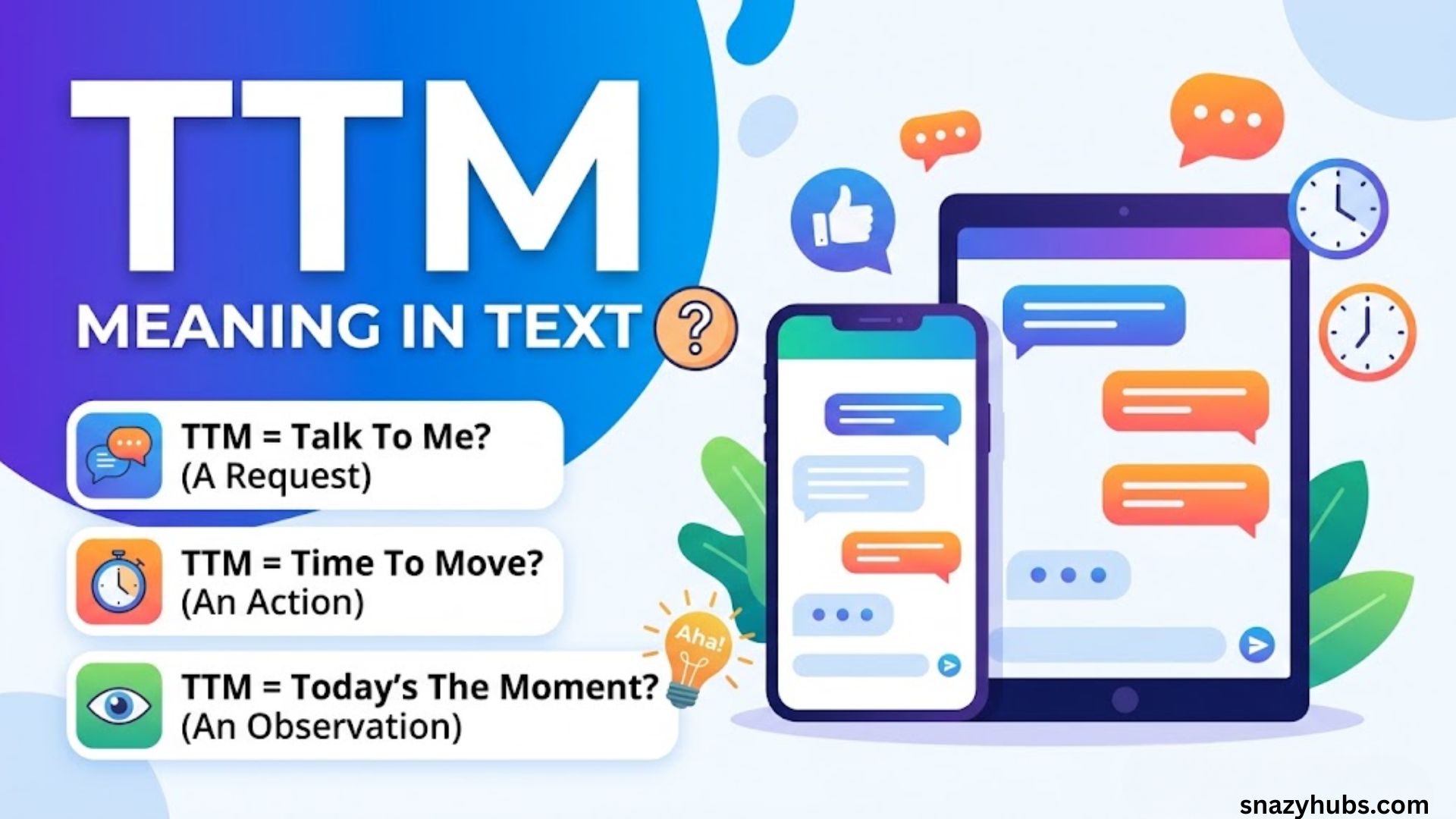
You’re scrolling through a chat, and someone drops “TTM” with nothing else attached. No context, no punctuation, just three letters sitting there. So what does TTM mean in text? In almost every case, it stands for “Talk To Me.” It’s a short, casual way of asking someone to start a conversation, keep one going, or simply reach out.
That’s the quick answer. But TTM meaning in text isn’t always that simple, and the letters carry different weight depending on where you see them, who sent them, and what came before. This guide breaks down every real meaning of TTM, from texting slang to finance to medicine, so you never have to guess again.
What TTM Means in Everyday Texting
The meaning of TTM in text messages almost always comes back to one phrase: Talk To Me. Someone sends it when they want to open a conversation or nudge one that’s gone quiet. It’s short, it’s low-effort to type, and it gets the point across without sounding needy or overly formal.
Think of TTM as a digital tap on the shoulder. It doesn’t demand a response the way a phone call does, but it signals interest. You’re telling the other person, “I’m here, and I’d like to hear from you.”
Here’s the thing about texting slang in general: it exists because typing full sentences on a phone is slow, and younger users especially value speed and casualness over polish. TTM fits neatly into that world. It’s part of a much larger family of texting slang, sitting alongside terms like HMU (hit me up) and WYD (what you doing), all built around the same goal of inviting a response with minimal typing.
Where You’ll See TTM in Text
TTM abbreviation shows up across nearly every messaging platform, though the exact usage shifts slightly depending on the app.
- Snapchat: People frequently ask what does TTM mean in Snap, and the answer stays consistent with general texting slang. It’s a quick way to invite a chat, often sent after someone posts a Snap story or as a follow-up to a snap that got no reply.
- Instagram: TTM meaning on Instagram usually shows up in comments, Story replies, or direct messages. Creators sometimes use it to encourage followers to slide into their DMs, while regular users use it the way they’d use it in any text.
- TikTok: Comment sections are full of TTM, often from viewers hoping a creator will respond, or from people flirting in the comments of a video.
- WhatsApp and iMessage: Here, TTM in texting tends to be more personal, usually between friends, family, or someone you’re interested in romantically.
- Group chats: TTM can also function as a general call for conversation when a group chat has gone quiet for a while.
Example Texts Using TTM
Seeing TTM in real sentences makes the meaning click faster than any definition alone.
- “Hey, it’s been forever. TTM when you get a sec.”
- “Rough day today. TTM if you’re free.”
- “Saw your story, that looked fun! TTM”
- “I have some news but don’t want to text it all out. TTM.”
- “You up? TTM lol”
Notice how the tone shifts in each one. Some sound casual and friendly. Others sound more personal, even urgent. That brings us to the part of TTM that trips people up the most: figuring out what it actually means emotionally.
Why People Use TTM Instead of Full Words
There’s a practical reason texting slang like TTM exists in the first place: speed. Typing “Talk To Me” takes a few extra seconds, and on a phone keyboard, those seconds add up fast when you’re firing off messages throughout the day. TTM does the same job in a third of the keystrokes.
There’s also a social layer to it. Spelling everything out in full sentences can come across as stiff or overly formal in a casual chat, especially between friends or people who talk often. Abbreviations like TTM signal familiarity. They tell the other person, “we don’t need to be formal here,” which is part of why you’ll rarely see TTM used with someone you don’t know well, at least not without it feeling a little out of place.
Abbreviations also travel well across platforms with character limits or fast-scrolling feeds, like X (formerly Twitter) or TikTok comments, where shorter is almost always better.
The Tone Behind TTM
Here’s a fact that surprises a lot of people: TTM doesn’t carry one fixed emotional weight. The words are always the same, but the feeling behind them depends entirely on context. Two people could send the exact same text, and one message could feel completely casual while the other feels loaded with meaning.
“The letters never change, but the person sending them always does. That’s where the real meaning of TTM in text hides.”
This isn’t unique to TTM. Most text slang without punctuation, without emojis, and without vocal tone, leaves plenty of room for interpretation. Your brain naturally fills in the gaps based on who’s texting you and your history with them.
Reading the Relationship
The safest way to decode TTM meaning in text is to think about who sent it, rather than trying to read the abbreviation on its own.
| Sender | Likely Meaning |
|---|---|
| Close friend | Casual, just wants to catch up |
| Family member | Usually straightforward, no hidden meaning |
| Romantic interest | Often flirty, an invitation to connect |
| Someone you just met | Could be testing the waters, mildly interested |
| A stranger online | Be cautious; treat it like any unsolicited message |
A TTM from your best friend after weeks of silence probably just means they miss talking to you. The same three letters from someone you’ve been quietly texting back and forth with for weeks might mean something closer to “I’ve been thinking about you.”
When TTM Feels Like an Invitation vs. a Demand
Most of the time, TTM is informal and low-pressure. It’s an invitation, not a command. Nobody’s obligated to respond immediately, and there’s no built-in urgency unless the surrounding words suggest otherwise.
That said, context words change everything. “TTM now” reads very differently from a plain “TTM.” Adding “please” or a string of exclamation points shifts the tone from a gentle nudge to something that feels more insistent. Reading the full message, not just the abbreviation, always gives you the clearest picture.
Other Common Meanings of TTM
While Talk To Me covers the overwhelming majority of everyday texting, TTM abbreviation isn’t exclusive to casual chats. It pops up in a handful of other fields with completely different meanings, and mixing these up can genuinely cause confusion if you’re reading something outside a normal text conversation.
Trailing Twelve Months (Finance)
In business and investing, TTM stands for Trailing Twelve Months. This refers to a company’s financial performance measured over the past twelve consecutive months, rather than a fixed calendar or fiscal year. Analysts use TTM data to get an up-to-date snapshot of revenue, earnings, or other metrics without waiting for a full annual report.
For example, if a company’s fiscal year ends in December but you want revenue figures as of September, TTM lets you calculate performance from the previous October through that September. It’s one of the most common tools in financial analysis, and if you ever see TTM in an earnings report or stock research tool, this is almost certainly the meaning intended.
Through The Mail (Autograph Culture)
Among collectors, TTM stands for Through The Mail, and it refers to a specific hobby: mailing items like photos, cards, or memorabilia directly to celebrities, athletes, or public figures in hopes of getting them signed and mailed back.
TTM in autograph culture has its own set of unwritten rules and etiquette. Collectors usually include a self-addressed stamped envelope (called an SASE) to make it easier and cheaper for the recipient to return the item. Success rates vary wildly depending on the celebrity, some respond to nearly every request, while others rarely or never do. Online communities and forums track which addresses work, how long a response typically takes, and which public figures are known for signing generously.
Targeted Temperature Management (Medical)
In medicine, TTM stands for Targeted Temperature Management. This is a clinical treatment used after cardiac arrest, where doctors deliberately lower and control a patient’s body temperature for a set period. The goal is to protect the brain and reduce the risk of neurological damage that can happen when blood flow is interrupted.
TTM replaced an older practice sometimes called “therapeutic hypothermia,” and it remains a standard part of post-cardiac-arrest care in many hospitals today. If you come across TTM in a medical article or hospital document, this is the meaning at play, and it has absolutely nothing to do with texting.
Trichotillomania (Mental Health)
In some mental health and psychology discussions, TTM is shorthand for Trichotillomania, a condition classified as a body-focused repetitive behavior disorder. People with trichotillomania feel a recurring urge to pull out their own hair, often from the scalp, eyebrows, or eyelashes, and the behavior is frequently linked to stress, anxiety, or as a coping mechanism.
You’ll typically see this abbreviation used in clinical settings, support communities, or academic writing about compulsive behaviors, not in casual conversation.
Quick Reference Table
| Meaning | Field | Typical Context |
|---|---|---|
| Talk To Me | Texting/Social Media | Everyday chats, DMs, comments |
| Trailing Twelve Months | Finance | Earnings reports, stock analysis |
| Through The Mail | Collecting/Autographs | Mailing items for celebrity signatures |
| Targeted Temperature Management | Medicine | Post-cardiac-arrest treatment |
| Trichotillomania | Mental Health | Clinical or support discussions |
TTM vs. Similar Texting Abbreviations
Because so much of texting slang relies on short letter combinations, mix-ups happen constantly. Two abbreviations in particular tend to get confused with TTM.
TTM vs. TMM
This is one of the most common mix-ups in texting. TTM meaning in text stands for Talk To Me, while TMM usually means “Tomorrow.” They look almost identical at a glance, especially when typed quickly or read on a small screen, but the meanings don’t overlap at all.
For example: “Let’s talk TMM” means “let’s talk tomorrow,” while “Let’s talk TTM” is closer to “let’s talk right now, whenever you’re free.” Mixing these up can lead to genuinely confusing conversations, so it’s worth slowing down and double-checking which one you’re actually looking at.
TTM vs. TTYL, HMU, and Other Contact Requests
TTM isn’t the only abbreviation built around inviting conversation, and it helps to understand how it differs from its closest relatives.
- TTYL (Talk To You Later) signals the end of a conversation, not the start of one.
- HMU (Hit Me Up) is similar to TTM but often implies a more specific request, like meeting up or getting more details on something.
- WYD (What You Doing) opens a conversation indirectly by asking about someone’s activity rather than requesting a chat outright.
TTM stands apart because it’s a direct, no-frills invitation. It doesn’t ask a question or wrap the request in anything else. It just states the intention plainly: talk to me.
How to Respond to TTM
Knowing how TTM is used on social media and in texting is only half the picture. The other half is knowing how to reply.
Casual Reply Examples
If you’re comfortable chatting, a simple response works fine:
- “Hey! What’s up?”
- “Here now, what’s going on?”
- “TTM back at you, been meaning to catch up.”
- “Sorry, been slammed. Free to talk tonight?”
When You’d Rather Not Respond
Not every TTM needs a full conversation in return, and that’s completely fine. If you’re busy or not in the mood to chat, a short, honest reply keeps things polite without over-explaining:
- “Kind of swamped right now, can we talk later?”
- “Not much to report, but thanks for checking in!”
- Simply reacting with an emoji on some platforms can also work as a low-pressure acknowledgment.
If a TTM comes from someone you don’t know, especially in DMs or comment sections, it’s reasonable to ignore it entirely or respond with caution. Not every message deserves a reply, and that’s a normal, healthy boundary online.
How to Decode TTM in Any Situation
By now, it should be clear that the meaning of TTM in text depends heavily on where you find it and who put it there. Rather than memorizing every possible scenario, it helps to run through a short mental checklist whenever you’re unsure.
Start with the platform. TTM meaning on Instagram or Snapchat almost always points to Talk To Me, since both apps are built around casual, personal messaging. If you’re reading a stock report or a hospital document, though, the odds shift dramatically toward Trailing Twelve Months or Targeted Temperature Management instead.
Next, look at the sender. A text from a friend, family member, or love interest is going to lean toward the everyday texting definition every time. A message inside a collector’s forum or autograph community points toward Through The Mail instead.
Finally, read the surrounding words. Slang rarely shows up in total isolation. Even a single extra word, like “now,” “please,” or a follow-up emoji, can shift the tone from relaxed to urgent, or from friendly to flirty. Context clues like these are usually enough to remove any real ambiguity within seconds.
Common Mistakes People Make With TTM
A few recurring errors show up again and again when people try to interpret TTM:
- Assuming it’s always romantic. Most of the time, TTM is simply friendly or neutral. Reading too much into it can create awkward misunderstandings.
- Confusing it with TMM. As covered earlier, these two abbreviations look alike but mean completely different things.
- Ignoring the platform. The same letters mean something entirely different in a finance app versus a group chat, and skipping that step leads to real confusion.
- Overthinking a single word. TTM by itself, without any other context, is genuinely just an invitation to chat. Not every text needs to be analyzed for hidden meaning.
Keeping these mistakes in mind makes texting slang a lot less stressful to navigate, whether you’re replying to a friend or scrolling through comments on social media.
Frequently Asked Questions
What does TTM mean in a text from a girl or guy?
The meaning stays the same regardless of who sends it: Talk To Me. What changes is the emotional undertone, which depends on your relationship with that person rather than their gender.
Does TTM always mean “Talk To Me”?
In texting and social media, yes, almost always. Outside of that context, though, TTM can mean Trailing Twelve Months, Through The Mail, Targeted Temperature Management, or Trichotillomania, depending on the field.
Is TTM flirty?
It can be, but it isn’t inherently flirty. TTM is neutral on its own. The flirtatious tone comes from who’s sending it and the conversation history you share with them, not from the abbreviation itself.
What’s the difference between TTM and TMM?
TTM means Talk To Me. TMM means Tomorrow. They’re easy to mix up visually, but the meanings are unrelated.
What does TTM mean in finance or medical contexts?
In finance, TTM stands for Trailing Twelve Months, a way of measuring a company’s performance over the past year. In medicine, it refers to Targeted Temperature Management, a treatment used after cardiac arrest to protect brain function.
Is TTM formal or informal?
TTM is informal. It belongs firmly in the world of texting slang and casual online communication. You wouldn’t use it in a work email, a formal letter, or professional correspondence of any kind.
Is TTM still popular today?
Yes. TTM remains a widely recognized and commonly used piece of digital communication, especially among younger texters and social media users. Its simplicity is exactly why it hasn’t faded out the way some slang eventually does.
Bottom Line
So, what does TTM mean in text? Nine times out of ten, it means Talk To Me, a simple, friendly way to open the door to conversation. The real skill isn’t memorizing the definition, it’s reading the context around it: who sent it, what platform you’re on, and what’s been said before. Get that right, and you’ll never be confused by a text that just says TTM again.
