

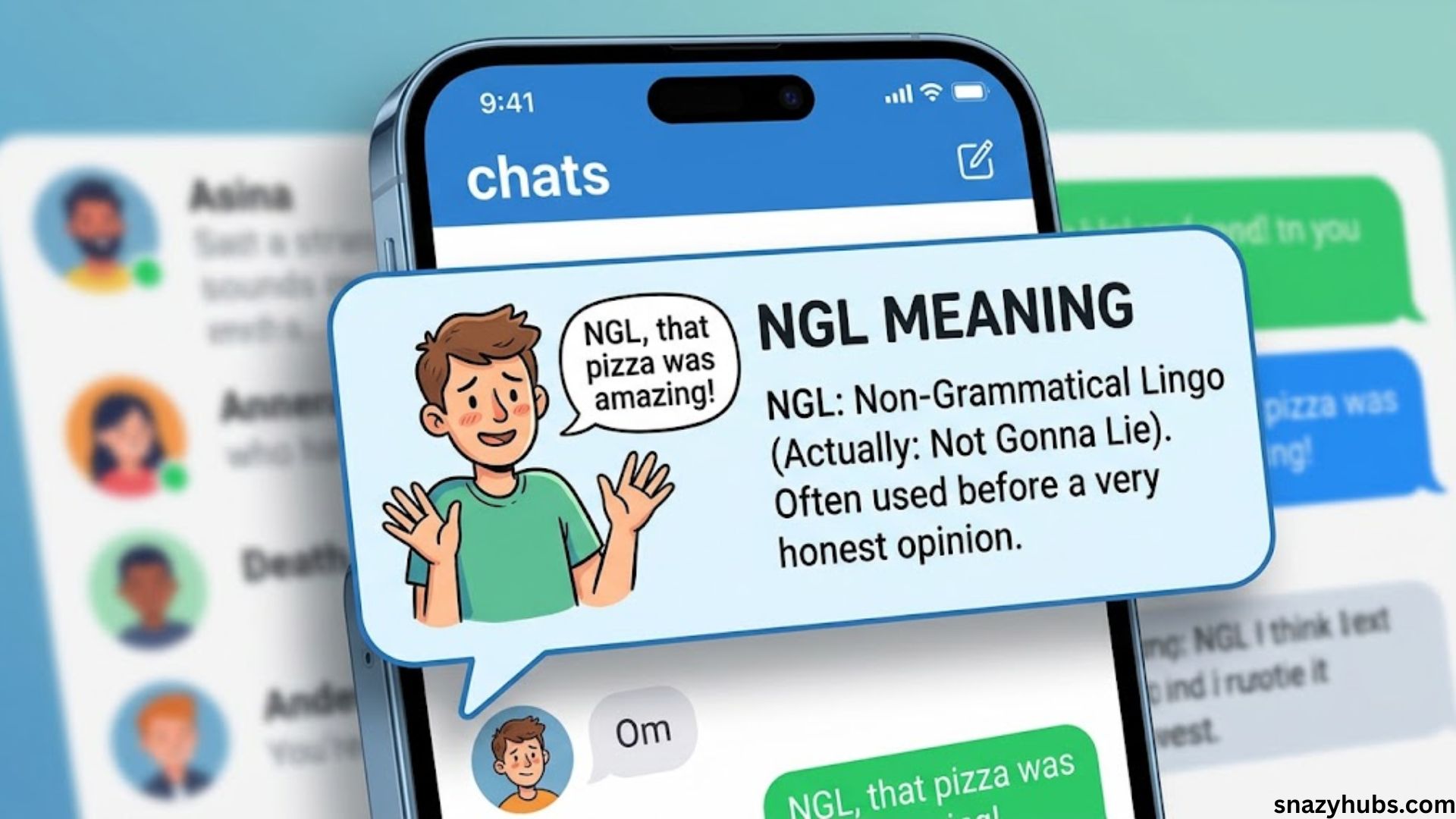
You’re scrolling through a group chat, and someone drops a message that starts with “ngl.” Maybe it’s a compliment. Maybe it’s a jab. Either way, you already know what’s coming: the truth, no filter attached.
That little three-letter tag has become one of the most common openers in modern texting, and it carries more weight than people realize. This guide breaks down the NGL meaning in text, where it came from, how tone changes its impact, and when you should (or shouldn’t) use it yourself.
Quick Answer
NGL stands for “not gonna lie.” People use it right before sharing an honest, sometimes blunt, opinion. Think of it as a verbal heads-up that says, “I’m about to tell you exactly what I think, so brace yourself.”
That’s the short version. Now let’s dig into the details, because there’s a lot more nuance packed into those three letters than most people assume.
What Does NGL Mean?
The Literal Definition
NGL is an abbreviation for “not gonna lie.” It’s the digital cousin of saying “honestly” or “to tell you the truth” out loud. When you see NGL at the start of a sentence, the writer wants you to know they’re skipping the sugarcoating.
Here’s a simple example:
“ngl, I forgot your birthday until this morning.”
No excuses, no cushioning. Just the truth, stated plainly. That directness is the entire point of NGL slang, and it’s why the abbreviation has stuck around instead of fading out like so many other internet acronyms.
Where It Fits Grammatically
NGL almost always shows up at the beginning of a sentence, functioning like a disclaimer. It rarely appears mid-sentence or at the end, though you’ll occasionally spot it tacked on afterward for emphasis, like “that movie was mid, ngl.”
Grammatically, it behaves like an adverbial phrase. It modifies the tone of the whole sentence rather than any single word. Compare it to “honestly,” “frankly,” or “to be real with you.” All four phrases do the same job: they signal that sincerity is about to take priority over politeness.
Where NGL Came From
Texting and Early Internet Shorthand
Long before smartphones, people were shrinking phrases down to survive character limits and slow typing speeds. Early instant messaging platforms like AIM and MSN Messenger, along with flip-phone texting plans that charged by the character, pushed users toward abbreviations. LOL, BRB, and TTYL all emerged from that same pressure cooker.
NGL followed the same pattern. Typing three letters instead of eleven saved time, and it fit naturally into the fast, informal rhythm of chat conversations. Unlike some acronyms that required insider knowledge to decode, NGL’s meaning was easy to guess even for newcomers, which helped it spread quickly once it caught on.
How It Spread Through Social Media
NGL picked up serious momentum once Twitter (now X) became a dominant platform for short-form, personality-driven posts. The 280-character limit rewarded efficient phrasing, and NGL fit right in.
From there, it jumped into TikTok captions and comment sections, then into Instagram Stories and captions. Each platform reinforced the same use case: a quick, punchy way to flag honesty before dropping an opinion, confession, or piece of feedback. By the time Gen Z had fully taken over these platforms, NGL had shifted from niche texting shorthand into mainstream digital vocabulary.
What NGL Signals When Someone Uses It
A Flag for Honesty
At its core, NGL functions as an honesty marker. It tells the reader that what follows isn’t filtered, softened, or performed for the sake of politeness. In a text-based world where tone is easy to misread, that little flag actually does a lot of communicative work.
Think about how much context gets lost without facial expressions or vocal tone. NGL helps fill that gap. It’s a small piece of punctuation for sincerity, letting the reader know exactly how to interpret what’s coming next.
A Softener for Blunt Statements
Here’s the part people often miss: NGL doesn’t just signal honesty, it also cushions the blow of an uncomfortable truth. Saying “ngl, that outfit isn’t it” feels less harsh than saying “that outfit isn’t it” without any lead-in.
The abbreviation works almost like a verbal shrug. It acknowledges that the opinion might sting a little, but frames it as unavoidable honesty rather than intentional cruelty. That’s a subtle but important distinction, and it’s a big reason why NGL in conversation feels more casual and less confrontational than a flat statement would.
Tone: When NGL Reads as Friendly vs. Harsh
Context changes everything with NGL. The same three letters can read as warm and playful in one message and sharp or dismissive in another.
Casual and Playful Use
Among friends, NGL often softens a compliment or a lighthearted confession. Examples include:
- “ngl, I binge-watched the whole season in one night.”
- “ngl, you were right about that restaurant.”
- “ngl, I kind of miss our old apartment.”
In these cases, the tone stays light. The honesty feels endearing rather than critical, and it often builds closeness between the people texting.
Blunt or Cutting Use
On the flip side, NGL frequently precedes criticism or an awkward truth that the other person might not want to hear:
- “ngl, that project needs a lot of work.”
- “ngl, I don’t think that’s a good idea.”
- “ngl, you kind of ghosted me for a week.”
Here, the tone shifts. The relationship between the texters, the subject matter, and even punctuation choices (a period feels colder than no punctuation at all) all influence how sharp the message lands. A close friend can get away with a blunt NGL message that would feel harsh coming from a coworker or acquaintance.
The rule of thumb: the closer the relationship, the more leeway NGL buys you. Use it carelessly with someone you don’t know well, and it can come across as unnecessarily blunt or even rude.
NGL in Real Conversations
Seeing NGL in action makes the meaning click faster than any definition alone. Here’s a table breaking down common examples across different contexts:
| Message | Context | What It Actually Communicates |
|---|---|---|
| “ngl, this coffee slaps” | Casual texting | Genuine, low-stakes opinion |
| “ngl, I’m not ready for finals” | Friend group chat | Honest admission of stress |
| “ngl, your last post was fire” | Instagram comment | Sincere compliment |
| “ngl, I don’t vibe with that show” | Conversation about media | Blunt but harmless opinion |
| “ngl, that was a bad move” | Feedback after a mistake | Direct criticism, softened slightly |
| “ngl, I miss how things used to be” | Personal or reflective text | Vulnerable, honest confession |
Notice how the phrase adapts to whatever emotional weight the sentence carries. That flexibility is exactly why NGL in texting has stayed relevant instead of becoming a dated trend like so many other short-lived slang terms.
NGL on Social Media Specifically
TikTok and Instagram Captions
On TikTok, NGL frequently opens captions attached to confessions, opinions, or reaction videos. A creator might post a video with the caption “ngl this took way longer than it should have,” instantly setting an honest, self-aware tone before the viewer even watches the clip.
Instagram follows a similar pattern, especially in caption text and Story replies. NGL meaning on Instagram tends to lean toward personal admissions or candid takes, things people want to say plainly without over-explaining themselves.
On X, NGL meaning often shows up in quote tweets or reply threads, especially when someone wants to push back on a popular opinion or admit something unpopular. The platform’s fast-paced, opinion-heavy culture makes NGL a natural fit.
The NGL App Connection
Here’s where things get a little confusing for newcomers. There’s also a standalone app called NGL (short for “not gonna lie”) that lets users receive anonymous messages, usually linked through Instagram Stories. It became hugely popular for anonymous Q&A-style interactions.
The app borrows its name directly from the slang term, since both center around the idea of unfiltered honesty. But they’re not the same thing. The abbreviation is a texting habit that predates the app by years, while the app is a specific product built around that same honesty-first concept. If someone mentions “sending an ngl,” they usually mean the app, not the phrase.
Common Mix-Ups and Misuse
Confused with Similar Acronyms
NGL often gets lumped in with other honesty-adjacent abbreviations, but each one carries a slightly different flavor:
| Acronym | Meaning | Typical Use |
|---|---|---|
| NGL | Not gonna lie | Precedes an honest, sometimes blunt opinion |
| TBH | To be honest | Similar to NGL, but often feels slightly softer |
| IMO | In my opinion | Frames a statement as subjective, not universal truth |
| FR | For real | Emphasizes sincerity or agreement, less about disclosure |
TBH and NGL get used almost interchangeably by a lot of texters, but there’s a subtle difference. NGL tends to carry more weight when the truth might be uncomfortable, while TBH feels a touch more neutral and easygoing. IMO, meanwhile, focuses on framing an opinion as personal rather than factual, which makes it less confrontational than either NGL or TBH.
When It’s Used Inauthentically
Not every use of NGL actually precedes something honest. Plenty of people slap it onto a sentence purely for stylistic rhythm, without any real “confession” behind it. Saying “ngl, I love pizza” doesn’t reveal a hidden truth, it’s just a common, universally agreed-upon preference dressed up in slang.
This kind of casual overuse doesn’t ruin the phrase, but it does dilute its impact a little. When every sentence starts with NGL, the honesty flag starts to lose meaning, similar to how “literally” gets overused until it stops meaning “literally” at all.
Is NGL Appropriate in Formal Writing?
Short answer: no, keep NGL out of professional emails, reports, and formal writing.
The abbreviation carries a casual, conversational tone that clashes with professional communication norms. Using it in a work email or business message can come across as unpolished or overly informal, even if your intent was just to sound direct and honest.
If you want that same “here’s the real talk” energy in a professional setting, swap NGL for phrases like:
- “To be candid,”
- “Honestly speaking,”
- “I’ll be direct,”
These alternatives capture the same spirit of honesty without sacrificing professionalism. Save NGL for texting, social captions, and casual conversation, where it belongs.
Frequently Asked Questions
What does NGL mean in texting?
NGL stands for “not gonna lie.” In texting, it signals that the sender is about to share an honest opinion, often one that might be slightly uncomfortable or blunt.
Is NGL rude or disrespectful?
Not inherently. NGL itself isn’t rude, but the tone of the sentence that follows it can be. Context and relationship closeness determine whether the message reads as playful honesty or harsh criticism.
What’s the difference between NGL and TBH?
Both phrases signal honesty, but NGL tends to carry slightly more weight, especially before criticism or an uncomfortable truth. TBH often feels a bit lighter and more neutral by comparison.
Can I use NGL in professional or formal writing?
It’s best to avoid it. NGL fits casual texting and social media, not professional emails or formal documents. Use phrases like “to be candid” or “honestly speaking” instead.
Is NGL related to the anonymous messaging app?
They share the same root meaning, but they’re different things. The slang term predates the NGL app by years. The app, popular for anonymous Instagram Q&A, borrowed the phrase because it fits the app’s honesty-focused concept.
Conclusion
NGL might only be three letters, but it carries a surprising amount of communicative nuance. At its core, the abbreviation flags honesty, softens blunt statements, and helps readers correctly interpret tone in a medium where facial expressions and vocal cues simply don’t exist.
Whether you spot it in a group chat, a TikTok caption, or an X reply, the NGL meaning in text stays consistent: someone is about to tell you the truth, and they want you to know it’s coming. Use it with people who’ll appreciate the directness, skip it in professional settings, and pay attention to context, because that’s really what determines whether NGL lands as friendly honesty or something sharper.
